


Photosynthetica 2025, 63(3):246-261 | DOI: 10.32615/ps.2025.021
Leaf gas exchange and photosynthetic light-response curves of cassava genotypes under drought stress during the early growth stage and after recovery
- 1 Faculty of Science and Health Technology, Kalasin University, 46000 Kalasin, Thailand
- 2 Department of Biology, Faculty of Science, Khon Kaen University, 40002 Khon Kaen, Thailand
- 3 Department of Agronomy, Faculty of Agriculture, Khon Kaen University, 40002 Khon Kaen, Thailand
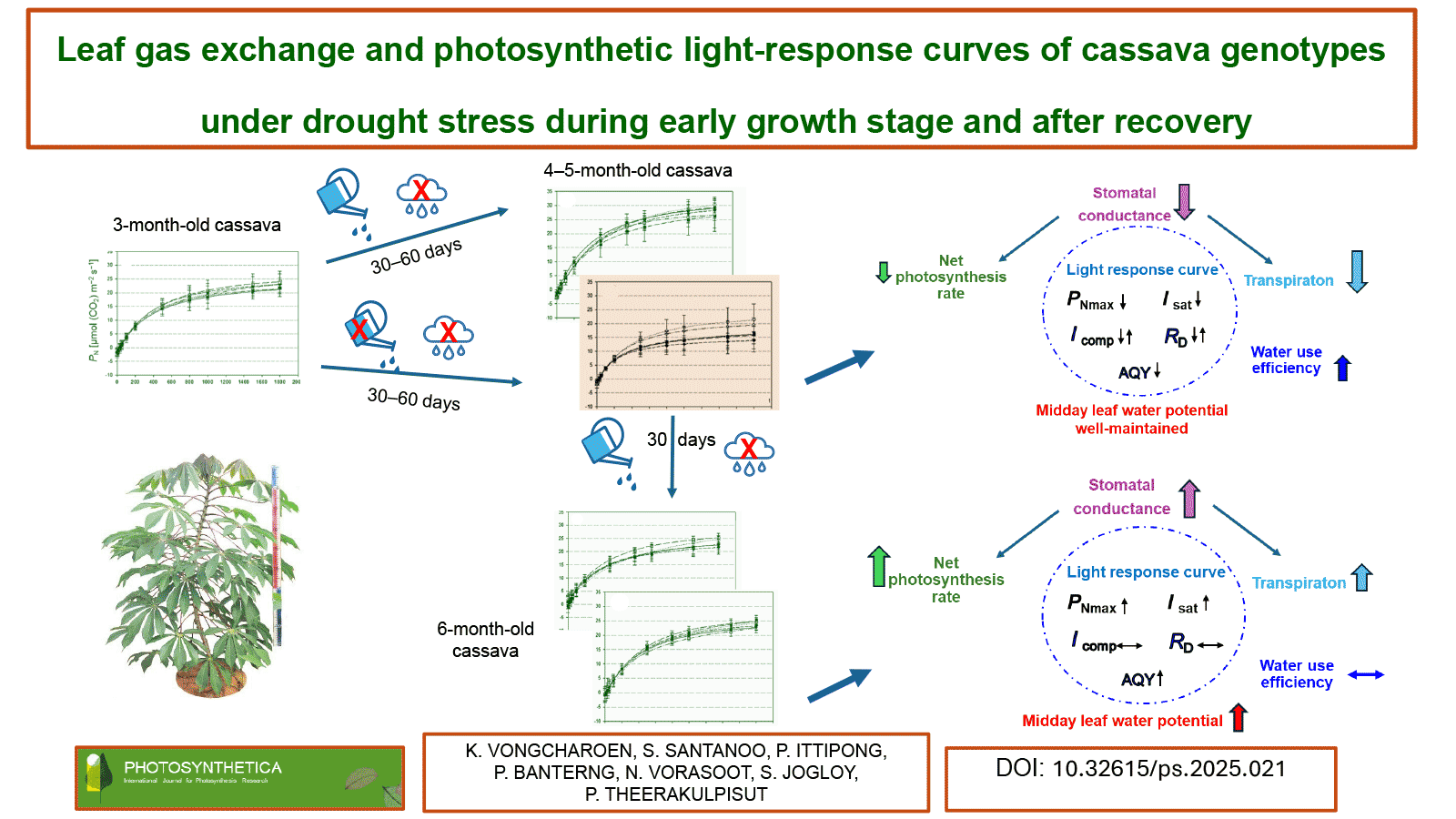
This study aimed to gain insights into the photosynthesis capacity and genotypic differences in response to drought imposed at an early growth stage of cassava. Leaf water potential (LWP), leaf gas exchange, and photosynthetic light-response curves were investigated in six field-grown cassava genotypes under full irrigation and drought imposed for 60 d during 3-5 months after planting. During the drought period, mean LWP at predawn (LWPpre) was significantly lower than that in the control plants, while the mean midday LWP (LWPmid) was similar. During the drought period, the mean stomatal conductance was reduced from 0.36 to 0.09 mol(H2O) m-2 s-1, mean transpiration rate from 5.30 to 1.86 mmol(H2O) m-2 s-1 with the concomitant reduction in net photosynthetic rate (PN) from 27.45 to 16.34 µmol(CO2) m-2 s-1. Analysis of the light-response curves revealed a reduction in the light-saturation point (Isat), the light-saturated net photosynthetic rate (PNmax), and the apparent quantum yield (AQY). After rewatering for 30 d, the drought plants could fully recover. In conclusion, PN at high light intensity, PNmax, Isat, and AQY were useful parameters to differentiate genotypes for variability in drought tolerance.
Additional key words: apparent quantum yield; cassava; drought; leaf water potential; photosynthesis.
Received: May 19, 2025; Revised: May 19, 2025; Accepted: June 26, 2025; Prepublished online: July 22, 2025; Published: October 15, 2025 Show citation
| ACS | AIP | APA | ASA | Harvard | Chicago | Chicago Notes | IEEE | ISO690 | MLA | NLM | Turabian | Vancouver |

Supplementary files
| Download file | Vongcharoen_3200_supplement.docx File size: 98.38 kB |
References
- Alves A.A.C., Setter T.L.: Response of cassava leaf area expansion to water deficit: cell proliferation, cell expansion and delayed development. - Ann Bot.-London 94: 605-613, 2004.
 Go to original source...
 - Bakayoko S., Tschannen A., Nindjin C. et al.: Impact of water stress on fresh tuber yield and dry matter content of cassava (Manihot esculenta Crantz) in Côte d'Ivoire. - Afr. J. Agr. Res. 4: 021-027, 2009.
- Chowdhury J.A., Karim M.A., Khaliq Q.A. et al.: Effect of drought stress on water relation traits of four soybean genotypes. - SAARC J. Agric. 15: 163-175, 2018. Go to original source...
- Cock J.H., Franklin D., Sandoval G., Juri P.: The ideal cassava planting for maximum yield. - Crop Sci. 19: 271-279, 1979. Go to original source...
- Cock J.H., Porto M.C.M., El-Sharkawy M.A.: Water use efficiency of cassava. III. Influence of air humidity and water stress on gas exchange of field grown cassava. - Crop Sci. 25: 265-272, 1985. Go to original source...
- Connor D.J., Palta J.: Response of cassava to water shortage. III. Stomatal control of plant water status. - Field Crop. Res. 4: 291-311, 1981. Go to original source...
- De Souza A.P., Massenburg L.N., Jaiswal D. et al.: Rooting for cassava: insights into photosynthesis and associated physiology as a route to improve yield potential. - New Phytol. 213: 50-65, 2017. Go to original source...
- De Souza A.P., Wang Y., Orr D.J. et al.: Photosynthesis across African cassava germplasm is limited by Rubisco and mesophyll conductance at steady state, but by stomatal conductance in fluctuating light. - New Phytol. 225: 2498-2512, 2020. Go to original source...
- Donovan L., Linton M., Richards J.: Predawn plant water potential does not necessarily equilibrate with soil water potential under well-watered conditions. - Oecologia 129: 328-335, 2001. Go to original source...
- El-Sharkawy M.A.: Effect of humidity and wind on leaf conductance of field growth cassava. - Rev. Bras. Fisiol. Veg. 2: 17-22, 1990.
- El-Sharkawy M.A.: Cassava biology and physiology. - Plant Mol. Biol. 56: 481-501, 2004. Go to original source...
- El-Sharkawy M.A.: Physiological characteristics of cassava tolerance to prolonged drought in the tropics: implications for breeding cultivars adapted to seasonally dry and semiarid environments. - Braz. J. Plant Physiol. 19: 257-286, 2007. Go to original source...
- El-Sharkawy M.A.: Prospects of photosynthetic research for increasing agricultural productivity, with emphasis on the tropical C4 Amaranthus and the cassava C3-C4 crops. - Photosynthetica 54: 161-184, 2016. Go to original source...
- El-Sharkawy M.A., Cock J.H.: Water use efficiency of cassava. I. Effects of air humidity and water stress on stomatal conductance and gas exchange. - Crop Sci. 24: 497-502, 1984. Go to original source...
- El-Sharkawy M.A., de Tafur S.M., Lopez Y.: Eco-physiological research for breeding improved cassava cultivars in favorable and stressful environments in tropical/subtropical bio-systems. - Environ. Res. J. 6: 143-211, 2012a.
- El-Sharkawy M.A., de Tafur S.M., Lopez Y.: Cassava productivity, photosynthesis, ecophysiology, and response to environmental stresses in the tropics: a multidisciplinary approach to crop improvement and sustainable production. -In: Ospina B., Ceballos H. (ed.): Cassava in the Third Millennium: Modern Production, Processing, Use, and Marketing Systems. Pp. 29-88. CIAT, Cali 2012b.
- El-Sharkawy M.A., Hernández A.D.P., Hershey C.: Yield stability of cassava during prolonged mid-season water stress. -Exp. Agr. 28: 165-174, 1992. Go to original source...
- Faralli M., Lawson T.: Natural genetic variation in photosynthesis: an untapped resource to increase crop yield potential? - Plant J. 101: 518-528, 2020. Go to original source...
- Garbulsky M.F., Peñuelas J., Papale D. et al.: Patterns and controls of the variability of radiation use efficiency and primary productivity across terrestrial ecosystems. - Glob. Ecol. Biogeogr. 19: 253-267, 2010. Go to original source...
- Gomez K.A., Gomez A.A.: Statistical Procedures for Agricultural Research. Pp. 704. John Wiley & Sons, New York 1984.
- Hauser S., Wairegi L., Asadu C.L.A. et al.: Cassava System Cropping Guide: A Manual of the Africa Soil Health Consortium. Pp. 64. CABI, Nairobi 2014.
- Howeler R.H.: Cassava mineral nutrition and fertilization. - In: Hillocks R.J., Thresh J.M., Bellotti A.C. (ed): Cassava: Biology, Production and Utilization. Pp. 115-147. CAB International, Oxon 2002. Go to original source...
- Kobza J., Edwards G.E.: Influences of leaf temperature on photosynthetic carbon metabolism in wheat. - Plant Physiol. 83: 69-74, 1987. Go to original source...
- Koundinya A.V.V., Nisha A., Ajeesh B.R. et al.: Early vigour: a key to drought tolerance in cassava based on physiological and biochemical traits including inherent non-enzymatic antioxidant activity. - Sci. Hortic.-Amsterdam 331: 113110, 2024. Go to original source...
- Lobo F.A., de Barros M.P., Dalmagro H.J. et al.: Fitting net photosynthetic light-response curves with Microsoft Excel - a critical look at the models. - Photosynthetica 51: 445-456, 2013. Go to original source...
- Ma X., Liu Q., Zhang Z. et al.: Effects of photosynthetic models on the calculation results of photosynthetic response parameters in young Larix principis-rupprechtii Mayr. plantation. - PLoS ONE 16: e0261683, 2021. Go to original source...
- Mahakosee S., Jogloy S., Vorasoot N. et al.: Seasonal variations in canopy size and yield of Rayong 9 cassava genotype under rainfed and irrigated conditions. - Agronomy 9: 362, 2019. Go to original source...
- MOAC (Ministry of Agriculture and Cooperatives, Thailand): Status of cassava in Thailand: Implications for future research and development, 2025. Available at: https://www.fao.org/4/y1177e/Y1177E04.htm.
- Pereira L.F.M., Santos H.L., Zanetti S. et al.: Morphology, biochemistry, and yield of cassava as functions of growth stage and water regime. - S. Afr. J. Bot. 149: 222-239, 2022. Go to original source...
- Pereira L.F.M., Zanetti S., Silva M.A.: Water relations of cassava cultivated under water-deficit levels. - Acta Physiol. Plant. 40: 13, 2018. Go to original source...
- Phosaengsri W., Banterng P., Vorasoot N. et al.: Leaf performances of cassava genotypes in different seasons and its relationship with biomass. - Turk. J. Field Crops 24: 54-64, 2019. Go to original source...
- Polthanee A., Promkhambut A.: Impact of climate change on rice-base cropping system and farmers' adaptation strategies in Northeast Thailand. - Asian J. Crop Sci. 6: 262-272, 2014. Go to original source...
- Posit Team: RStudio: Integrated Development Environment for R. Posit Software, Boston 2024. Available at: https://www.r-project.org/conferences/useR-2011/abstracts/180111-allairejj.pdf.
- Punyasu N., Kalapanulak S., Saithong T.: CO2 recycling by phosphoenolpyruvate carboxylase enables cassava leaf metabolism to tolerate low water availability. - Front. Plant Sci. 14: 1159247, 2023. Go to original source...
- R Core Team: R: A Language and Environment for Statistical Computing. R Foundation for Statistical Computing, Vienna 2023. Available at: https://www.r-project.org/.
- Ren Y., Wang H., Harrison S.P. et al.: Reduced global plant respiration due to the acclimation of leaf dark respiration coupled with photosynthesis. - New Phytol. 241: 578-591, 2024. Go to original source...
- Rodriguez-Dominguez C.M., Forner A., Martorell S. et al.: Leaf water potential measurements using the pressure chamber: synthetic testing of assumptions towards best practices for precision and accuracy. - Plant Cell Environ. 45: 2037-2061, 2022. Go to original source...
- Rosenthal D.M., Slattery R.A., Miller R.E. et al.: Cassava about-FACE: Greater than expected yield stimulation of cassava (Manihot esculenta) by future CO2 levels. - Glob. Change Biol. 18: 2661-2675, 2012. Go to original source...
- Ruangyos C., Banterng P., Vorasoot N. et al.: Variation in biomass of cassava genotypes grown under different irrigation levels during the early growth phase. - Crop Sci. 64: 482-495, 2024. Go to original source...
- Sanders G.J., Arndt S.K.: Osmotic adjustment under drought conditions. - In: Aroca R. (ed.): Plant Responses to Drought Stress. Pp. 199-229. Springer, Berlin-Heidelberg 2012. Go to original source...
- Santanoo S., Ittipong P., Banterng P. et al.: Photosynthetic performance, carbohydrate partitioning, growth, and yield among cassava genotypes under full irrigation and early drought treatment in a tropical savanna climate. - Plants-Basel 13: 2049, 2024. Go to original source...
- Santanoo S., Vongcharoen K., Banterng P. et al.: Canopy structure and photosynthetic performance of irrigated cassava genotypes growing in different seasons in a tropical savanna climate. - Agronomy 10: 2018, 2020. Go to original source...
- Sawatraksa N., Banterng P., Jogloy S. et al.: Chlorophyll fluorescence and biomass of four cassava genotypes grown under rain-fed upper paddy field conditions in the tropics. - J. Agron. Crop Sci. 204: 554-565, 2018. Go to original source...
- Scholander P.F., Bradstreet E.D., Hemmingsen E.A., Hammel H.T.: Sap pressure in vascular plants: negative hydrostatic pressure can be measured in plants. - Science 148: 339-346, 1965. Go to original source...
- Sekhar K.M., Sreeharsha R.V., Reddy A.R.: Differential responses in photosynthesis, growth and biomass yields in two mulberry genotypes grown under elevated CO2 atmosphere. - J. Photoch. Photobio. B 151: 172-179, 2015. Go to original source...
- Shan Z., Luo X., Wei M. et al.: Physiological and proteomic analysis on long-term drought resistance of cassava (Manihot esculenta Crantz). - Sci. Rep.-UK 8: 17982, 2018. Go to original source...
- Singsaas E.L., Ort D.R., DeLucia E.H.: Variation in measured values of photosynthetic quantum yield in ecophysiological studies. - Oecologia 128: 15-23, 2001. Go to original source...
- Tombesi S., Frioni T., Grisafi F. et al.: The decrease of leaf dark respiration during water stress is related to leaf non-structural carbohydrate pool in Vitis vinifera L. - Plants-Basel 11: 36, 2022. Go to original source...
- Turnbull M.H., Murthy R., Griffin K.L.: The relative impacts of daytime and night-time warming on photosynthetic capacity in Populus deltoides. - Plant Cell Environ. 25: 1729-1737, 2002. Go to original source...
- Vongcharoen K., Santanoo S., Banterng P. et al.: Seasonal variation in photosynthesis performance of cassava at two different growth stages under irrigated and rain-fed conditions in a tropical savanna climate. - Photosynthetica 56: 1398-1413, 2018. Go to original source...
- Wang H., Atkin O.K., Keenan T.F. et al.: Acclimation of leaf respiration consistent with optimal photosynthetic capacity. - Glob. Change Biol. 26: 2573-2583, 2020. Go to original source...
- Wasonga D.O., Kleemola J., Alakukku L., Mäkelä P.S.A.: Growth response of cassava to deficit irrigation and potassium fertigation during the early growth phase. - Agronomy 10: 321, 2020. Go to original source...
- Watananonta W., Tangakul S., Katong S. et al.: Effect to methods of land preparation on the yields of four cassava cultivars in Thailand. - Acta Hortic. 703: 225-231, 2006. Go to original source...
- Wright I.J., Reich P.B., Atkin O.K. et al.: Irradiance, temperature and rainfall influence leaf dark respiration in woody plants: evidence from comparisons across 20 sites. - New Phytol. 169: 309-319, 2006. Go to original source...
- Xiong D., Nadal M.: Linking water relations and hydraulics with photosynthesis. - Plant J. 101: 800-815, 2020. Go to original source...
- Yang Y., Guo Y.: Elucidating the molecular mechanisms mediating plant salt-stress responses. - New Phytol. 217: 523-539, 2018. Go to original source...
- Yavas I., Jamal M.A., Din K.U. et al.: Drought-induced changes in leaf morphology and anatomy: overview, implications and perspectives. - Pol. J. Environ. Stud. 33: 1517-1530, 2024. Go to original source...
- Yu L., Luo X., Zhao R. et al.: The spatiotemporal variations in ecosystem photosynthetic quantum yield and their drivers. - Agr. Forest Meteorol. 365: 110466, 2025. Go to original source...